
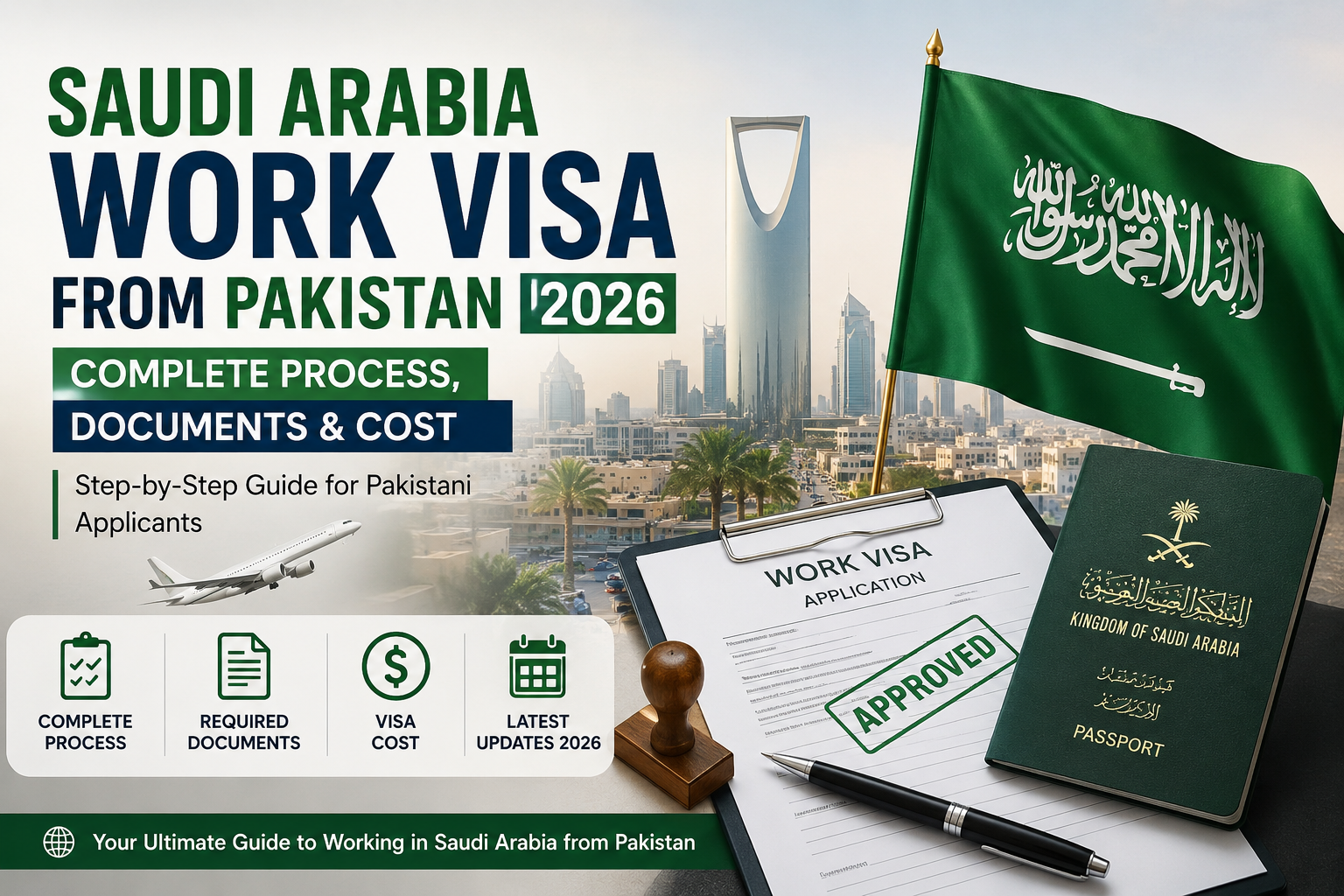
Saudi Arabia continues to be the top destination for Pakistani workers looking for overseas employment, from skilled trades and technicians to engineers and hospitality staff. But the visa process involves several government departments, document attestation stages, and medical checks — and a single mistake at any stage can delay your travel by weeks. This guide walks you through the entire Saudi Arabia work visa process from Pakistan in 2026, step by step, so you know exactly what to expect before you start.
How the Saudi Work Visa Process Works
Saudi Arabia’s work visa system runs on employer sponsorship (the Kafala system). This means you cannot apply for a work visa on your own — a Saudi employer must first offer you a job and initiate the sponsorship process on your behalf. Once that happens, the process on the Pakistan side generally follows this order:
Job offer and contract – A Saudi employer issues a signed employment offer confirming your role, salary, and terms.
Employer-side approval – The employer secures work permit authorization through Saudi Arabia’s Ministry of Human Resources and Social Development (via the Qiwa platform), then applies for a Visa Authorization Number through the Ministry of Foreign Affairs (MOFA).
Document attestation – Your educational certificates, experience letters, and other credentials must be verified and attested before the embassy will accept your application.
Medical fitness test (GAMCA) – A mandatory health screening at an approved medical center.
Police clearance certificate – Issued by Pakistan’s relevant authority, usually required for most job categories.
Embassy visa stamping – Submission of your documents at the Saudi Embassy or Consulate for final visa issuance.
BEOE/Protector clearance – Emigration clearance from Pakistan’s Bureau of Emigration and Overseas Employment before you’re legally allowed to travel for work.
Travel and Iqama – After arrival, your employer processes your Iqama (residency permit), which you’re required to carry at all times.
Documents You’ll Need
Keep these ready before you begin, since incomplete paperwork is the single biggest cause of delay:
- Valid passport with at least 6 months’ validity and 2 blank pages
- Signed employment contract and offer letter from the Saudi employer
- MOFA Visa Authorization Number (provided by your employer)
- Attested educational certificates and professional credentials
- Experience letters (attested, where applicable)
- GAMCA medical fitness report
- Police Clearance Certificate
- Recent passport-size photographs (white background)
- Trade or skill certification for technical roles (electricians, welders, technicians, etc.)
Engineers typically need PEC registration alongside degree attestation, while healthcare workers need additional credential verification through the relevant medical council, which can add several weeks to the timeline.
Where Document Attestation Fits In
This is the stage that trips up most applicants. Before the Saudi Embassy will accept your degree or experience certificates, they generally need to pass through a defined attestation chain — often starting with the relevant board or HEC, then Ministry of Foreign Affairs (MOFA) attestation in Pakistan, and finally embassy attestation at the Saudi mission. Any mismatch in names, missing stamps, or an incomplete chain results in rejection and resubmission, which is exactly the kind of delay that pushes a 6-week process into 3 months.
If you’re unsure which documents need which type of attestation, it’s worth getting this checked before you submit anything — not after a rejection. 4U Visa’s embassy attestation service and MOFA attestation service handle this end-to-end, so documents go in correctly the first time.
Timeline: How Long Does It Take?
From gathering documents to departure, most applicants should budget 4 to 10 weeks, depending on how quickly each stage is completed:
| Stage | Typical Duration |
|---|---|
| Document attestation | 1–2 weeks |
| GAMCA medical test (result) | 3–7 days |
| Police clearance certificate | 7–14 days |
| Embassy visa stamping | 1–3 weeks |
| BEOE/Protector clearance | 2–5 days |
Healthcare professionals should add extra time for credential verification, and peak hiring seasons can extend embassy processing further.
Cost of a Saudi Work Visa from Pakistan
For most job categories arranged through a genuine employer, the employer covers the core visa costs — work permit fees, visa authorization, and often the flight. Your own out-of-pocket costs are typically limited to:
- Document attestation charges
- GAMCA medical test fee
- Police clearance certificate fee
- Passport and photograph costs
- Any agent/consultancy service fee, if you use one
Be cautious of anyone asking for a large lump sum for a “guaranteed” or “Azad” (free) visa — a genuine employer-sponsored visa does not require you to pay a stranger for visa access. If someone asks you to transfer money to a personal account, treat it as a warning sign.
How to Avoid Common Delays and Scams
- Verify the employer before accepting any offer — a real Saudi employer will have a registered company and a traceable hiring process.
- Never pay “visa fees” to individuals or into personal bank accounts.
- Get your document attestation chain checked before submission, not after a rejection notice.
- Complete your medical test at an approved center only — results from unapproved clinics are not accepted.
- Register your emigration with BEOE before departure; travelling for work without clearance can create legal problems for you back home.
Which Job Categories Are in Demand?
Saudi Arabia continues to hire heavily across construction, technical trades, hospitality, and industrial sectors. Categories with consistent demand include electricians, AC/HVAC technicians, machine operators, mechanical assembly workers, factory workers, cooks, and design/mechanical engineers. If you’re exploring which roles currently have open positions, you can browse live job openings on 4U Visa.
How 4U Visa Can Help
Getting a Saudi work visa is manageable when the paperwork is right the first time. 4U Visa supports Pakistani workers through the parts of the process that cause the most delays:
- Embassy Attestation for degrees, experience letters, and personal documents
- MOFA Attestation for ministry-level document verification
- Medical Token booking for your GAMCA/fitness test
- Embassy Appointment scheduling
- Work Visa services covering the full application process
If you’re ready to start, contact 4U Visa and our team will walk you through exactly what your specific job category needs.
Frequently Asked Questions
Can I apply for a Saudi work visa without a job offer? No. Saudi Arabia’s work visa system is entirely employer-sponsored — you need a confirmed job offer before the process can begin.
How long does the whole process take from Pakistan? Most applicants complete the process in 4–10 weeks, depending on how quickly attestation, medical, and police clearance are completed.
What is the age limit for a Saudi work visa? Generally 18–60 years for most labor and trade categories, though skilled professionals and engineers can qualify up to 65, and domestic worker categories have a lower upper limit. Requirements vary by employer and sector, so confirm eligibility for your specific role.
Is the GAMCA medical test mandatory? Yes, for all applicants. The test must be done at an approved medical center — results from other clinics will not be accepted by the embassy.
Can I change employers after arriving in Saudi Arabia? Yes, under current labor reforms, workers who have completed two years with an employer (or whose contract has ended) can transfer to a new employer without the current employer’s permission, through the official transfer platform.
Have questions about your specific job category or documents? Get in touch with 4U Visa for guidance tailored to your case.